slipstream
A coding-agent platform plugin that swaps whole-file reads for precise tools, keeps context alive across compaction, and stands up a live local dashboard — a pixel office where every open tab is a character at a desk, so I can see who is doing what while it happens. The runner I ship with.
- mainrunning
- sp-shipperstep 4/7
- sp-reviewerwaiting
- + sp_symbol(retrieve.ts, retrieveSymbol)
- + sp_lines(server.ts, 40, 92)
- ~ sp_remember(decision)
- + sp_map()
- [x] orient with sp_map
- [x] slice retrieveSymbol
- [ ] wire PreCompact hook
- [ ] verify with /doctor
The live dashboard, mocked. Real one renders on 127.0.0.1, refreshes over SSE.
Why this exists
A long coding-agent session usually dies one of two ways. The agent reads whole files until the context window fills and starts forgetting the start of its own plan. Or it does good work, the session ends, and every decision it made evaporates. I write small production sites on Cloudflare, Supabase, Vercel and Resend, and I lean on the agent in my IDE for the boring parts. Both of those failure modes were biting me every long day.
The first failure mode is whole-file context bleed. The agent opens a 1,200 line component to change one prop. The budget bleeds. Three prompts later it has paged out the convention we agreed on at the top. Slipstream answers this with a bundled MCP server: a compact sp_map of the project, and sp_symbol / sp_lines for surgical slices. One symbol in, not one file in.
The second failure mode is the compaction cliff. The window summarises, the durable facts go with the noise. I tried writing everything into a single hand-rolled notes file. It rotted within a day. Slipstream answers this with a structured memory store, a PreCompact hook that writes a session digest the instant before the trim, and a signal-ranked recall that reloads only the relevant subset on the next session.
Then I added the thing I actually wanted most: a window into the session. When you fire off a plan and a subagent and walk away, you should be able to glance at a tab and see which agent is on which step and where the budget is. That is the live local dashboard, and it is the headline feature.
Watch the agents work
Session start boots a small 127.0.0.1 server on a free port and prints the URL into chat. Four panels, themed in the SarmaLinux palette, refreshed over SSE.
Agents
Every agent and subagent, its status (running, waiting, done, failed) and the task it is on. Grouped so a subagent's work does not tangle with the main thread.
Activity
The per-agent stream of prompts, tool calls and results as they land. The append-only event log behind it makes replay free.
Token budget
A bar that fills as reads pull bytes into context. With sp_* tools on, the bar crawls. With whole-file reads, it lurches.
Plan + mind map
The current plan and a Mermaid mind map of the session's agents, redrawn as events arrive. Same renderer as /slipstream:mindmap.
Honest about what it is
It is a local observability dashboard for your session. It watches and visualises, it does not drive. Nothing leaves the machine, there is no telemetry, the bind is 127.0.0.1 only, and obvious secrets are pattern-redacted before they ever reach the log. Auto-open lives behind a setting in .claude/slipstream/dashboard.json, and SLIPSTREAM_DASHBOARD=0 disables it per session.
Before and after, real token numbers
Numbers from this repository on my machine (Apple Silicon, Node 25), using slipstream's own conservative 3.6 bytes-per-token estimate from src/context/budget.ts.
| Approach | Bytes into context | Approx tokens | Saving |
|---|---|---|---|
| Whole-file Read of src/map/retrieve.ts | 4,841 | ~1,345 | baseline |
| sp_symbol(retrieve.ts, retrieveSymbol) | 1,381 | ~384 | 71% fewer |
| Reading every file in src/ | 146,150 | ~40,597 | naive orient |
| sp_map index instead | 7,821 | ~2,173 | 5.4% of reading everything |
The dashboard's token-budget bar makes this visible while it happens. With the tools on, the bar crawls. With whole-file reads, it lurches. The discipline that prevents sp_symbol from ever returning the whole file lives in src/mcp/tools.ts where it cannot be bypassed.
The bundled MCP tools
Fourteen tools, served over stdio by dist/mcp/index.js. Every one returns the smallest correct thing.
sp_mapThe compact project map: every file, its exported symbols and a one-line purpose. No file contents. The agent orients with this before it reads anything.
sp_symbolJust that symbol's source slice, with its doc comment. Walks braces from the declaration line. A single call replaces opening the whole file.
sp_linesExactly that line range, bounded. No surrounding context, no leakage. For when the slice you want is a block, not a symbol.
sp_searchRanked file locations for a query. Returns locations, not contents, so the agent decides what to slice next.
sp_rememberWrite a durable Markdown fact into the memory store under .claude/slipstream/memory/. Survives compaction. Reloaded on next session.
sp_recallRead memories back into the turn. With a query, ranks by signal. Without, returns the index. Capped under a ~1,200 token ceiling.
sp_forgetRemove a stale fact. The MEMORY.md index regenerates so the durable view stays clean.
sp_search_memoryNEW in v0.5.1. Cheap ranked index over self-built observations. Returns id, time, kind, one-line summary. Scan here, go deeper only if it pays.
sp_timelineNEW in v0.5.1. Chronological neighbours of an observation, by id or by the best match for a query. The middle layer of three-layer recall.
sp_observationsNEW in v0.5.1. Full bodies for the ids you have filtered down to. The final, expensive layer of recall. Pay only here.
sp_budgetThe context-budget level (ok / warn / compact). Inside Claude Code, reads the real context-window occupancy from the session transcript. Estimated elsewhere; paste actualTokens to calibrate.
sp_savingsNEW in v0.5.1. Exact bytes-saved-versus-whole-file figure for every scoped read, in every editor. Drives the opt % statusline segment and the Session work panel.
sp_dashboardNEW in v0.5.1. Returns the dashboard URL. The MCP server auto-starts the dashboard on first call, so it works in Cursor, Windsurf and Antigravity too.
sp_mindmapThe project rendered as a themed Mermaid mind map, returned to chat or written to a self-contained HTML artifact.
Deep dive: MCP-Tools wiki → . Token-Efficiency →
Lossless compaction + smart recall
The two memory features that make a long session survivable. One catches the thread before it is trimmed. The other refuses to dump the whole store back on the next start.
Lossless compaction
The agent platform fires PreCompact just before it summarises and trims the conversation, which is exactly the moment the thread tends to blur. slipstream's hook reconstructs what happened from the dashboard event log, builds a structured digest (open task, decisions, files touched, next step) in src/memory/digest.ts, and writes it to the store as a durable fact.
On the next session start it is reloaded first, so a resumed session picks up where it left off rather than from a lossy summary. The hook is idempotent. If the session is resumed mid-compact, the digest is updated, not duplicated.
Smart recall, not load-everything
A naive memory layer dumps the whole store back into context every session, which costs more tokens the larger and more useful it grows. slipstream instead builds a task signal from the git branch, the files changed in the working tree and the last prompt, ranks memories against it (src/memory/recall.ts), and reloads only the relevant subset under a hard ~1,200 token ceiling, plus the MEMORY.md index for the rest.
With no signal it loads nothing and defers to the index, because loading arbitrary memories with no signal is the behaviour we are avoiding.
Recall, diagrammed
Signal-ranked recall on session start. Empty signal short-circuits to nothing.
One line in the status bar
Context budget level, durable memory count, active skill, model. The formatting is a pure function, unit-tested in src/statusline, so the bar never lies about the helper underneath.
cp | ctx 12%* ok (~12 steps) | mem 4 | obs 37 | opt 71% | skill scoped-read
Terse output style
A bundled output style under output-styles/slipstream.md tuned for high-signal, low-token answers. Switch to it with /output-style slipstream to spend fewer tokens per turn without losing precision. Pairs with the statusline so the cost stays visible.
/output-style slipstream
# answers go terse, code blocks lean, no fluff
Three shipped subagents
Lean, token-disciplined subagents under agents/, each using the MCP tools rather than whole-file reads. Delegate with the Task tool, for example "use sp-reviewer to check this before I push".
Scaffold to deployed
Drives a small production site through the integration skills end to end: scaffold, wire auth, set up Supabase with row-level security, deploy to Cloudflare or Vercel, attach a domain, send the first transactional mail. Every shipping skill has a verification gate the agent must run; sp-shipper refuses to advance past a red one.
Postgres + RLS
Designs and migrates a Supabase / Postgres schema with row-level security that denies by default and explicit policies per role. Uses sp_symbol and sp_lines instead of reading whole migration files, so it stays inside budget even on a real codebase.
Pre-push guardrail
Runs lint, build, the test suite and a secret scan, then delivers a clear FAIL verdict that blocks the push when something is off. Designed to be invoked as "use sp-reviewer to check this before I push", so the green light is a discrete, auditable step.
Slash commands
Nine commands under commands/. Each is a thin wrapper around the helper, audited in one file, unit-tested where shape matters.
| Command | What it does |
|---|---|
| /slipstream:doctor | End-to-end install verifier. 12+ PASS / FAIL checks: MCP server built and declared, every hook wired, memory store reachable, helper CLI built, statusline and output style present, manifest valid. |
| /slipstream:map | Build the compact project map once. Walks the tree, records exported symbols and a one-line purpose per file, writes the index the agent will read from. |
| /slipstream:remember | Save a durable decision to the memory store. One Markdown file per fact with frontmatter, plus a regenerated MEMORY.md index. |
| /slipstream:recall | Pull facts back into the turn. With a query, signal-ranks against the working tree. Without, returns the durable index for the agent to scan. |
| /slipstream:forget | Drop a stale fact by slug. Index regenerates so the durable view stays clean. Used when a decision is reversed. |
| /slipstream:status | One screen: current plan, context-budget level with recommendation, durable memory count, project map size. |
| /slipstream:mindmap | Render the project as a themed Mermaid mind map. Inline in chat or written to a self-contained HTML artifact under .claude/slipstream/dashboard/. |
| /slipstream:dashboard | Print the dashboard URL again. Useful after a reload. Starting is idempotent so the running server is reused. |
| /slipstream:validate | Run plugin-validate against the manifest. Fails loudly on a malformed skill or a missing hook declaration. |
Architecture, end to end
Hooks, helper, MCP server, map, memory, event log, dashboard. Same diagram as the README, themed for the site.
The five pillars
Scoped-read tools, durable memory, lossless compaction, the live dashboard, the statusline. Each one earns its place.
Precise tools, not whole-file reads
A bundled MCP server (src/mcp) exposes sp_map, sp_symbol, sp_lines and sp_search. The agent orients with the map and pulls one declaration or one line range. The discipline lives in src/mcp/tools.ts where it cannot be bypassed.
Memory builds itself, and you can search it
NEW in v0.5.1. Every turn is folded into a compact observation with a local 256-float embedding, no database, no native module. Three-layer search (sp_search_memory for cheap index, sp_timeline for context, sp_observations for full bodies) makes weeks-old work recoverable without anyone writing it down.
Lossless context across compaction
A PreCompact hook writes a structured digest of the session (open task, decisions, files touched, next step) to the memory store the instant before Claude Code trims the window. The next session reloads it first, then signal-ranks the rest.
Live pixel office, in any IDE
Session start boots a 127.0.0.1 server and prints the URL. The home view is a live pixel office: every open tab is a character at a desk, animated by what it is doing right now (typing, reading, running), with the live file in a speech bubble and tokens saved as the hero figure. Click a character for its session story. Alongside it: digest-first Sessions, a What-is-learned view, and an interactive code map. Inside Claude Code the hooks feed it; in Cursor, Windsurf, Antigravity and VS Code the MCP server feeds and auto-starts it.
True context tokens and a universal opt %
NEW in v0.5.1. Inside Claude Code the statusline reads the real context-window occupancy from the session transcript (shown as ctx 47%* with the asterisk marking it exact). The opt % savings figure is exact in every editor because each scoped read records the bytes it served versus the whole-file baseline. cp | ctx 12% ok | mem 4 | obs 37 | opt 71% | skill scoped-read.
The new tabbed dashboard
Five tabs on one local URL bound to 127.0.0.1, fully offline, no CDN. The same data the agent works through, surfaced as a calendar heatmap, a donut chart, a file leaderboard, a per-day journal and a session manager. Six editor install paths: Claude Code, Cursor, Windsurf, Antigravity, VS Code with MCP and JetBrains via MCP.
Live tab
KPI strip with sparklines, agents list, filterable activity timeline, plan, inline SVG mind map, per-skill activity panel and the in-place token budget editor. The view that powered v0.6, kept intact.
Project tab
Six project-wide KPIs (sessions, observations, files, opt %, memories, drift) plus a 365-day GitHub-style activity heatmap clickable per day, a file leaderboard with violet-gradient bars and an inline-SVG donut chart for observations by kind.
Journal tab
Per-day digest with six tiles (observations, sessions, files, drift, tools, skills), top files for the day as a bar chart, tools used as colour-coded pills and a sessions-on-this-day list. Prev / today / next navigation.
Sessions tab
Full project sessions table with open and delete actions per row. Destructive delete is gated behind a confirmation modal. The active session is flagged in-line.
Memory tab
Full-project observation search with kind filter chips (edit, plan, decision, search, map, error, run) and colour-coded result badges. Click a hit to expand the full detail.
Doctor cross-IDE checks
duplicate-registration only fires when the plugin is actually loaded at runtime (v0.7.2). double-emit and stale-dashboard catch the rest of the cross-IDE setup pitfalls.
Agents office, every Claude Code tab on the project as a character at a desk.
Open several Claude Code tabs on one project and each one appears in the Agents office view, fed live from the shared local bus. Every character carries the title of what that tab is currently doing, the agent id, the working state, and the files in flight. The dashboard reads as a small open-plan studio: you can watch the whole team at once. Tabs see each other at turn boundaries and stop duplicating work.
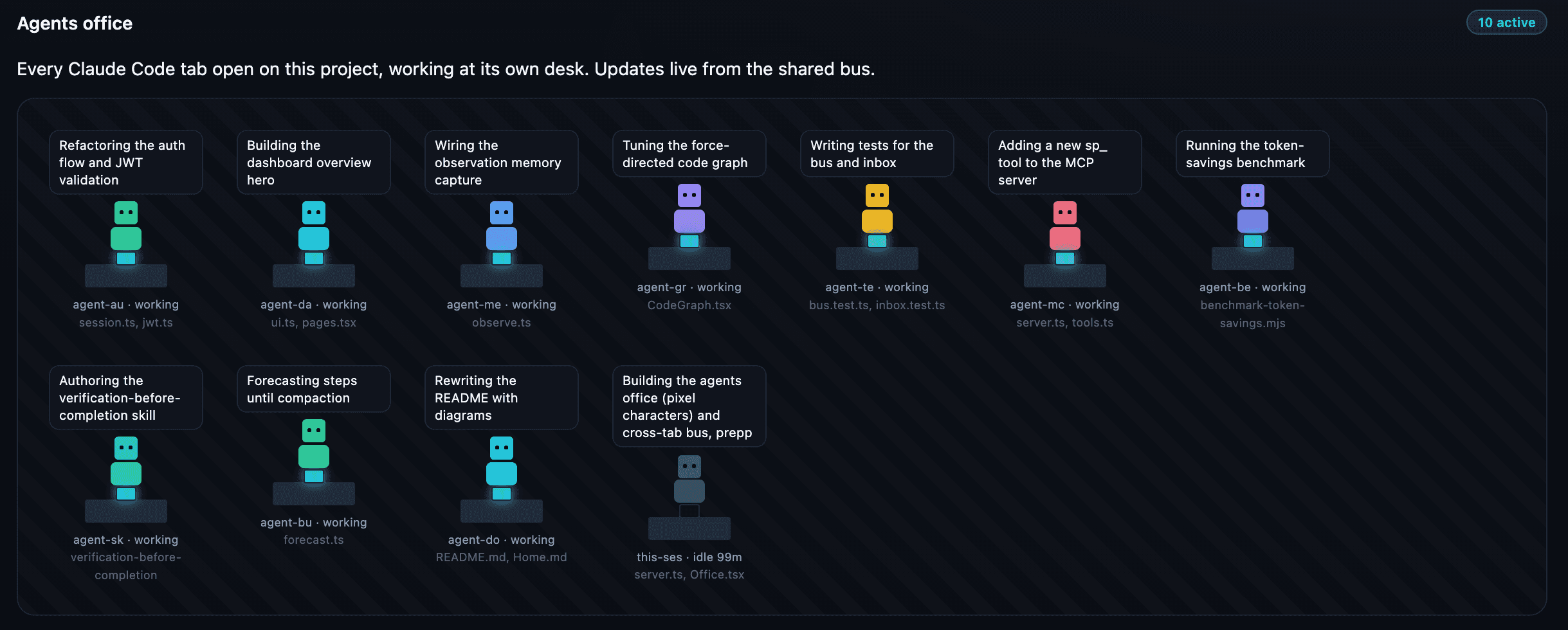
Captured 6 Jun 2026 on the slipstream repo itself. Each character animates while its tab is active (typing, blinking) and dims when idle. The Agents office view is part of the new v1.0 React dashboard.
Everything that landed in the first major release
Twelve features ship in v1.0.0: the React dashboard with nine routed views, the cross-tab agent bus, the cold-start knowledge feed, the interactive d3 code dependency graph, the reproducible token-savings benchmark, the dollar cost of tokens saved, the memory doctor, downloadable session reports, the insights band, the project knowledge brief, forceful per-turn steering and 75 skills.
React dashboard
A Vite + React + TypeScript SPA with nine routed views: Overview, Live activity, Said and done, Full conversation, Project stats, Daily journal, Sessions, Memory and the code graph. Grouped sidebar (Now / History / Knowledge), typed JSON client, design-token system, built into static assets that the same node:http server serves at 127.0.0.1.
Cross-tab agent bus
Multiple Claude Code tabs open on one project now coordinate. Each posts its open thread and files in flight to a shared local bus at turn end; every session sees the others at start and on each prompt. Tabs build on each other instead of duplicating work.
Cold-start knowledge feed
Every session opens with a freshly built bounded brief injected by the SessionStart hook: what the project is, how it is organised, the most-connected files to read first, what was recently asked and what is remembered. No session starts ignorant of the app.
Interactive code dependency graph
Files as nodes, imports as edges, force-directed in d3 with zoom, pan, drag, search and area colouring. Click any node to read its imports and importers. Also slipstream graph on the CLI and /api/codegraph, so Claude can read the structure too.
Reproducible token-savings benchmark
pnpm benchmark runs scripts/benchmark-token-savings.mjs against real files and emits a Markdown table comparing whole-file reads with scoped symbol reads. Anyone can regenerate the ~95% per-read figure. Honest about per-read, not end-to-end.
Dollar cost of tokens saved
Scoped-read savings now show as a money figure on the Overview and the Live tab, with the assumed per-million rate stated so the number is honest. via /api/savings and /api/overview.
Memory doctor
A terminal health check for the memory store: total, duplicates, stale and a by-type breakdown. Exits non-zero when the store needs attention so a script can gate on it.
Downloadable session reports
A session can be exported as a Markdown document: the said-to-did story plus a summary, from a link on the Flow tab. The honest version of team sharing.
Insights band
Every data tab opens with a natural-language band: one paragraph plus three to five bullets describing the view, not just tabulating it. Live, Project, Journal and Sessions each get their own template. Deterministic, zero LLM, fully reproducible.
Project knowledge brief
slipstream brief dumps everything slipstream knows about a project into one Markdown document: what it is, how it is organised, the durable memory, lessons and recent work. CLI + /api/brief + a download button on Overview.
Forceful steering
A using-slipstream skill plus a per-turn hook reminder now insist on scoped reads over whole-file reads and on recording durable memory every turn. The discipline that makes the savings real.
75 skills
A growing methodology and design library: think-before-coding, write-plan, systematic-debugging, scoped-read, context-budget, compact-and-offload, and 69 more covering planning, testing, design tokens and ops.
From the first commit to today
Every release, in order, with what changed and why it mattered. Eleven tagged versions in two months. Every figure here matches the git tags on github.com/sarmakska/slipstream.
First public commit
Two scoped tools, sp_map and sp_lines. No memory yet, no dashboard. Token savings measurable but the tool surface was thin.
PreCompact hook + memory store
Lossless compaction landed. Sessions started surviving compaction. Memory was opt-in via /slipstream:remember.
Statusline + budget gauge
A status line that shows context %, memory count, opt % savings. Budget thresholds with explicit warn and compact tiers.
Live agent dashboard, first cut
A local 127.0.0.1 server with SSE, a session selector and a Mermaid mind map. Worked but the visuals were utilitarian.
Self-building observation memory + three-layer search
Tool calls turn into observations automatically. Local 256-float embedding for semantic recall. sp_search_memory, sp_timeline, sp_observations.
Windows fix + cross-IDE foundation
PR #1 fixed the MCP stdio entry guard for Windows path separators. True context tokens read from the host transcript. Universal opt %.
Cross-IDE parity + nine features + redesigned dashboard
sp_digest and sp_resume bring lossless compaction to Cursor, Windsurf, Antigravity. slipstream-setup wires every editor idempotently. Map watcher, token forecast, replay export, configurable redaction, per-skill opt %, CI mode, drift detection, hook latency guard, doctor one-line fixes. New glass-on-dark dashboard with sparklines, pause control, offline inline mind map.
/api/health, version-aware restart, doctor cross-IDE checks
Dashboard advertises version, pid and startedAt. sp_dashboard now restarts a stale dashboard from a previous build. Three new doctor checks catch duplicate-registration, double-emit and stale-dashboard. A stable .claude/slipstream/dashboard.url is written on every start.
Tabbed dashboard: Project, Journal, Sessions, Memory
The dashboard gains four new tabs on top of Live. Project tab adds a 365-day GitHub-style heatmap, a file leaderboard, an inline-SVG kinds donut and a distilled-lessons grid. Journal tab shows per-day digests with prev/today/next navigation, clickable straight from the heatmap. Sessions tab lists every session with open and delete actions, gated behind a confirmation modal. Memory tab adds kind filter chips on the full-project search. Six new project endpoints power it all, still 127.0.0.1 only.
Windows hook telemetry persists
emit() used to spawn a detached child and exit before the write ran, silently losing every hook event on Windows. emit() now writes in-process and every hook awaits it. stop folds the turn in-process with captureObservations instead of a detached spawn. serverInfo.version reads from package.json with a regression test asserting the two stay in lockstep.
MCP-only observation memory populates
foldObservations gains an opt-in flushOpen so the trailing open turn materialises when no closing stop event arrives. The four memory-reading sp_ tools call captureObservations({flushOpen:true}) against every session when detectMode reports mcp-only. Cursor, Windsurf and Antigravity see a populated memory the moment they query it.
Dashboard insights band
Every data tab now opens with a natural-language band: one paragraph plus three to five bullets describing the view, not just tabulating it. Live names the session, tool count, opt percentage and files in focus. Project names the dominant focus directory and drift flags. Journal summarises one day. Sessions ranks sessions and flags hot or quiet ones. Deterministic templates, zero LLM, fully reproducible.
Reproducible token-savings benchmark
scripts/benchmark-token-savings.mjs and pnpm benchmark measure whole-file reads versus scoped symbol reads on real files and emit a Markdown table. Anyone can regenerate the number. Honest about per-read, not end-to-end, efficiency.
Project knowledge brief
slipstream brief dumps everything slipstream knows about a project into one Markdown document: what it is, how it is organised, the durable memory, lessons and recent work. Available as a CLI, an Overview download button and /api/brief, so a fresh session picks the project up cold.
Production React dashboard
A Vite + React + TypeScript SPA in web/ replaces the server-rendered page: a left sidebar with nine routed views (Overview, Live, Flow, Conversation, Project, Journal, Sessions, Memory, Graph), a design-token system, a typed JSON client and an interactive knowledge graph. Builds to dist/dashboard/web and serves from the same node:http server.
Interactive code dependency graph
A graphify-style d3 view of how the codebase wires together: files as nodes, imports as edges, force-directed with zoom, pan, drag, search and area colouring. Click any node to read its imports and importers. Also slipstream graph on the CLI and /api/codegraph, so Claude can read the structure too.
Cold-start knowledge feed
Every session opens with a freshly built knowledge feed injected by SessionStart: what the project is, how it is organised, the most-connected files to read first, what was recently asked and what is remembered. No session starts ignorant of the app.
First major release
Cross-tab agent bus so multiple Claude Code tabs on one project coordinate at turn boundaries. ~95% per-read token savings, reproducible via pnpm benchmark. Forceful steering via the using-slipstream skill and a per-turn hook reminder, so the optimisation tally actually climbs and memory grows constantly. React dashboard with nine real-data views, interactive code graph, 75-skill methodology library, 321 tests, CI green.
What is in the box
Everything below is shipped today and covered by the test suite (321 tests across 47 files).
PreCompact session digest
A hook reconstructs the open task, decisions, files touched and next step from the dashboard event log, then writes one structured fact to memory before the window is trimmed. The next session reloads it first.
Signal-ranked recall
On session start, recall builds a task signal from the git branch, the files changed in the working tree and the last prompt, ranks memories against it and reloads only the relevant subset under a hard token ceiling. With no signal it loads nothing.
Hand-rolled MCP server
A small newline-delimited JSON-RPC stdio loop, no SDK dependency. The slice of the protocol in play (initialize, tools/list, tools/call) is small and stable. The request handler is a pure exported function so tests drive it without spawning a process.
Three shipped subagents
sp-shipper drives a site from scaffold to deployed across integration skills, refusing to advance past a red verification gate. sp-schema designs and migrates a Supabase schema with row-level security that denies by default. sp-reviewer is a pre-push guardrail with a hard FAIL verdict.
Terse output style
A bundled output style tuned for high-signal, low-token answers. Switch to it with /output-style slipstream to spend fewer tokens per turn without losing precision.
Local-only by construction
The dashboard binds 127.0.0.1 on a free port. Nothing leaves the machine. Obvious secrets are pattern-redacted before they reach the event log. No telemetry, no accounts, no hosted layer.
Append-only event log
Every lifecycle hook (SessionStart, UserPromptSubmit, PreToolUse, PostToolUse, SubagentStop, Stop, PreCompact) writes one JSON event to .claude/slipstream/dashboard/<session>.jsonl. State is a pure fold over the log, so replay is free.
Doctor end to end
/slipstream:doctor checks the MCP server is built and declared, every hook is wired, the memory store is reachable, the helper CLI is built, the statusline, output style and subagents are present, and the plugin manifest is valid. PASS / FAIL per check.
Run it in any IDE
Two layers. The full plugin (skills, hooks, memory, lossless compaction, statusline, live dashboard) runs inside a coding-agent host that loads the plugin format. The MCP tools, the token-saving core, are standard Model Context Protocol and work in any MCP-capable editor.
In a plugin-capable agent host
You get the bundled MCP server, the slash commands, the 75 skills, every lifecycle hook, the live dashboard, the statusline, the terse output style and the three subagents. Node 20 or newer on your PATH.
# In your coding-agent host
/plugin marketplace add sarmakska/slipstream
/plugin install slipstream

# Then, in the project
/slipstream:map        # build the project map once
/slipstream:doctor     # verify the install end to end
/slipstream:status     # plan, budget, memory count, map
In Antigravity, Cursor, Windsurf and other MCP editors
These editors do not load the host's plugin format, so the skills, hooks, slash commands and dashboard are not available there. The fourteen sp_* tools are. Build the server once, then register the absolute path under your editor's mcpServers block.
# Any MCP-capable editor: Cursor, Windsurf, Antigravity, others
git clone https://github.com/sarmakska/slipstream
cd slipstream
pnpm install
pnpm build

# Register the server (paths vary by editor)
# Cursor: .cursor/mcp.json
# Windsurf: ~/.codeium/windsurf/mcp_config.json
# Antigravity: Settings -> MCP
{
  "mcpServers": {
    "slipstream": {
      "command": "node",
      "args": ["/absolute/path/to/slipstream/dist/mcp/index.js"]
    }
  }
}Instead of whole-file reads
// What sp_map returns at orient time, JSON in chat
{
  "files": [
    { "path": "src/map/retrieve.ts",
      "purpose": "retrieve a symbol or line range from a file",
      "symbols": ["retrieveSymbol", "retrieveLines"] }
  ]
}

// What sp_symbol returns instead of opening the whole file
/** Walk braces from the declaration line to return one symbol slice. */
export function retrieveSymbol(file: string, symbol: string): string { /* ... */ }How slipstream changes the shape of a session
Orient, pull, compact, reload. The hook writes a durable digest the instant before the trim, the next session reloads it first.
Detailed setup, every editor
Step-by-step install for Cursor, Windsurf, Antigravity, VS Code with Claude Code and plain VS Code via MCP, with copy-paste config and a capabilities matrix.
Install slipstream in any IDECross-IDE Support wiki → · Run-in-Any-IDE → · Install-in-VS-Code →
slipstream is not affiliated with or endorsed by Anthropic. Claude and Claude Code are trademarks of Anthropic, referenced here only to describe compatibility.
vs other context-saving approaches
Honest about the trade-offs. A hand-written instructions file is free but it rots. A summariser is automatic but it is lossy by design. Manual notes are precise but they evaporate the moment you stop typing them.
| Concern | slipstream | Hand-written instructions file | Summariser tool | Manual notes |
|---|---|---|---|---|
| Reads cost | Slice or symbol | Whole-file by default | Whole-file then summarise | Whole-file by default |
| Memory across sessions | Structured store + index | Single hand-written file | Lossy summary | Manual rewrite |
| Compaction safety | PreCompact digest, lossless | Loses what is not in the file | Lossy by design | Loses everything |
| Recall strategy | Signal-ranked, ~1,200 token cap | Always loaded, full file | Whatever the summariser kept | Whatever you remember to paste |
| Watching the agent | Live dashboard + replay | None | None | None |
| Statusline | Budget, mem, skill, model | None | None | None |
| Verification gates | 75 skills, each gated | None | None | Whatever you wrote |
| Data leaves the machine | Never | Never (it is just a file) | Depends on tool | Never |
| License | MIT | – | Varies | – |
Full comparison page in the wiki, with the design rationale behind each choice: Comparisons →
A guardrailed skill library
Fifty-nine skills under skills/, grouped by area. Each shipping skill carries a verification gate, a real check the agent must pass before advancing. The library targets the stack I actually ship on, not a universal scaffolder.
frontendtailwind, forms, router, dark-mode, responsive-layout, component-library
backendhono-api, zod-validation, error-handling, rate-limit, openapi
supabaseinit, schema, rls, auth, edge-function, storage, typegen
cloudflareworker, pages, d1, kv, r2, secrets
vercellink, env, preview, deploy
resendsetup, domain, transactional, webhook
authsession, password-reset, oauth, rbac
paymentsstripe-setup, checkout, subscriptions, webhooks
seometa-tags, open-graph, structured-data, sitemap
analyticsplausible, web-vitals, events
gitinit-repo, feature-branch, conventional-commit, pull-request, release-tag
memory + contextmemory-capture, memory-recall, memory-prune, scoped-read, context-budget, compact-and-offload
Full catalogue: Skill-Catalogue wiki → . How the engine runs them → . Writing a skill →
/slipstream:doctor
A one-shot end-to-end install verifier. Fifteen checks, each PASS or FAIL with the exact reason. Run it after install, run it after upgrades, run it when something feels off.
The doctor walkthrough: Troubleshooting wiki →
Tech stack
Boring on purpose. The MCP path has zero runtime dependencies. The server path uses only node:http, no Express, no socket library. The event store is a JSONL file, not a database.
Frequently asked
More in the wiki FAQ →
Do I have to use the full plugin to get the token savings?+
No. The MCP tools (sp_map, sp_symbol, sp_lines, sp_search, sp_remember, sp_recall, sp_forget, sp_budget, sp_mindmap) are standard Model Context Protocol. They register in any MCP-capable editor: Antigravity, Cursor, Windsurf, others. The skills, hooks, dashboard and lossless compaction need the host plugin layer; that is the trade-off.
Is the token budget accurate?+
It is a conservative estimate from bytes-into-context at ~3.6 bytes per token, not the real internal counter. It is tuned to warn early and compact a little before it has to. The wording everywhere says "estimate". I would rather be honestly approximate and conservative than precise-looking and wrong.
Does anything leave the machine?+
No. The dashboard server binds 127.0.0.1 on a free port. The memory store is files in your project. The event log is a JSONL file. There is no telemetry, no accounts, no hosted layer. Obvious secrets are pattern-redacted before they reach the log, but treat redaction as belt-and-braces rather than a vault.
What happens during the long session?+
Reads stay slice-sized because the agent is nudged to use sp_symbol and sp_lines. The PreToolUse hook warns before a large whole-file read. Just before the platform compacts, the PreCompact hook writes a structured digest of the open task, decisions and next step. The next session reloads that digest first and signal-ranks the rest.
Can the dashboard steer the agents?+
No, by design. It observes, it does not control. It cannot pause a tool call or redirect a subagent. The honest framing is "a local observability dashboard for your session". If you want control plane, that is a different product.
Why a hand-rolled MCP server instead of the SDK?+
The slice of the protocol the agent loop drives is small and stable: initialize, tools/list, tools/call. A plugin that bundles a server should add as little as possible to the install. The cost is I implement the framing; the benefit is zero runtime dependencies on the MCP path and a server I can audit in one file. The request handler is a pure exported function so tests drive it directly.
Does it work in Cursor, Windsurf, Antigravity, JetBrains?+
Yes. Six editor install paths: Claude Code, Cursor, Windsurf, Antigravity, VS Code with MCP and JetBrains (IntelliJ, PyCharm, WebStorm, GoLand, RustRover, Android Studio) via the JetBrains AI Assistant MCP host. Build the server once, register the absolute path under your editor mcpServers block, and the agent gains all fourteen sp_* tools, the new React dashboard with nine routed views (Overview, Live, Flow, Conversation, Project, Journal, Sessions, Memory, Graph), the interactive code dependency graph, the budget gauge, the dollar cost of tokens saved and the reproducible per-read savings figure. Skills, slash commands, statusline and lossless compaction via the PreCompact hook stay Claude Code only; sp_digest and sp_resume bring cross-editor compaction for the rest. Detailed setup at /products/slipstream/setup.
Is it production-ready?+
v1.0.0 shipped 6 June 2026, so yes by my own standard. 321 tests across 47 files: dashboard event validity, the concurrency-safe append-only writer under 25 parallel writers, a real SSE server end to end, idempotent start, the React dashboard typed client over the JSON API, the cross-tab agent bus, the code dependency graph and force layout, the cold-start knowledge feed, the dollar-cost-of-tokens-saved math, the reproducible benchmark, the PreCompact digest builds and reloads, signal-ranked recall returns only the relevant subset within budget, the statusline string is pinned, and doctor (memory and install) runs against both the real tree and a deliberately broken one. CI green.
Ready to ship a sane long session?
Star the repo, drop it into your agent host, build the map once and run doctor. The next long session stops bleeding tokens and keeps its thread.